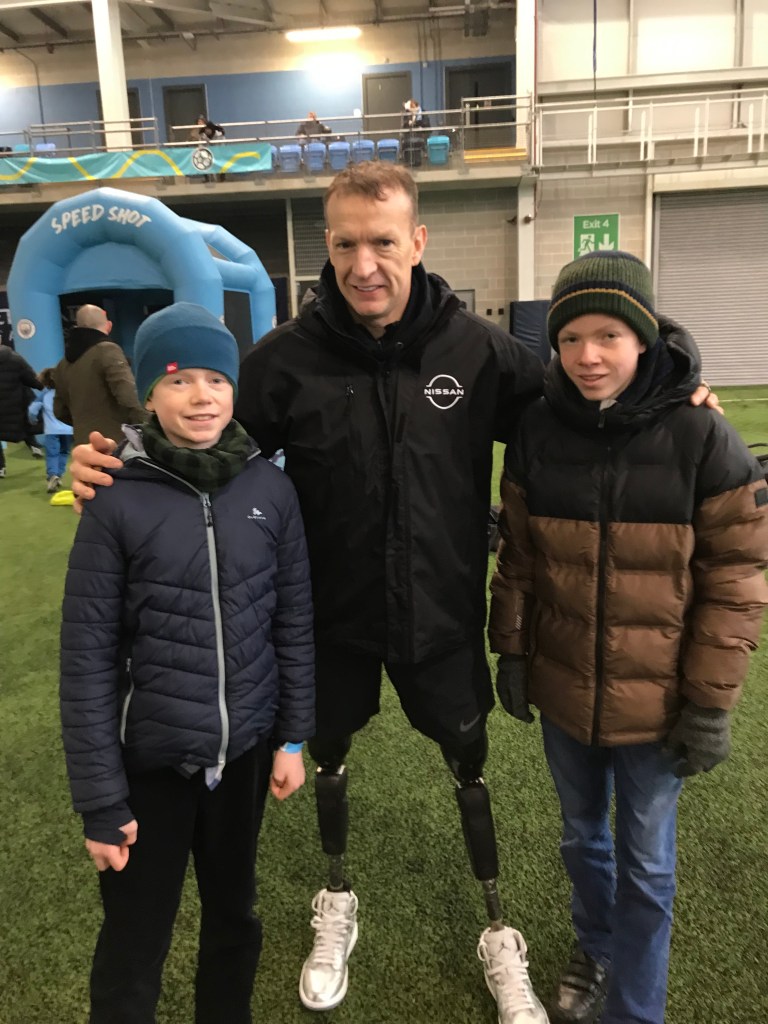
Double amputees don’t usually become elite athletes, but then, Richard Whitehead has always believed in living a “life without limits”.

Richard Whitehead is definitely unconventional and rebellious. The way he runs is certainly unlike any other elite athlete.
Sprinters will tell you that the start is the crucial element of a race. To get away cleanly on the gun is clearly important but then it’s a question of who can get into their optimum sprinting position first, since realistically, the race is won by the athlete with the highest average top speed. Whitehead, however, doesn’t even use a block start technique that other athletes utilise to launch themselves, instead, his standing start relies on flapping of elbows to get going before he can start to swing his pelvis and prosthetic running ‘blades’.
Look again at the T42 men’s 200m final at the London 2012 Paralympics. Of the nine athletes in the final, Whitehead is one of only two, with two prosthetic legs and is the only one with what might be described as a lateral running style, while others pump their legs in a more traditional up and down method.
At the halfway point, Whitehead is in second to last place but has just hit top speed and finishes the race ten metres in front of the other athletes, setting a new World Record of 24.39 seconds leaving the old record of 24.93 very much in the past. Not only is it a fine piece of physical athleticism, it also clearly demonstrates the mental strength of a person who has been doing things differently his whole life, as a disabled person.
The disability journey is one that takes problem solving to the extreme. Disabled people are very often rebels. How frequently do they hear the phrase: “No you can’t”?
Endurance
What also underlines Whitehead as a rebel is that sprinting is not even his first choice event. Whitehead is a marathon runner.
Richard Whitehead became a marathon runner to raise money for sarcoma research, after the loss of a close friend to bone cancer. He’d also been inspired by the well-known amputee, Terry Fox, and although he’d never even run a mile previously, he applied to enter the New York Marathon. Furthermore, he was using sports cups, since he didn’t at that time have any prosthetic legs, and intended to effectively run the marathon on his knees – a very painful and arduous undertaking indeed. In the end, a sports equipment manufacturer supplied him with running blades and he completed his first marathon on those.
In 2010 Whitehead broke his previous World Record for athletes with lower-limb amputations, with a time of 2:42:5 at the Chicago Marathon but sadly, the forthcoming London Paralympics in 2012 had no lower leg amputee classification for the marathon discipline and the International Paralympic Committee denied him the opportunity to compete against athletes with different classifications. In rebellious style, Whitehead began the qualification journey towards the T42 200m.
Whitehead was born in Nottingham and has a double through-knee congenital amputation. Also worth mentioning is that he represented ParalympicsGB at sledge hockey in the Winter Games in Turin in 2006 as a 20-year-old. By the time he crossed the finish line at London 2012 he was 36 years old.
Fundraising
In 2013, he started a fundraising campaign, Richard Whitehead Runs Britain, running from John O’Groats to Land’s End, raising money for Sarcoma UK and Scope and in 2011 he launched The Richard Whitehead Foundation.
At the 2016 Rio Paralympics, Whitehead won gold and broke his own World Record in the T42 200 metres and also took silver in the T42 100 metres, which he shared with Daniel Wagner of Denmark, when they finished in a dead heat. Among other highlights, Whitehead has won four IPC World Championship titles, and three European Championship titles. In 2013, he was awarded an MBE for services to athletics.
Once said: “It’s not all been rosy; I’ve had difficult situations where I’ve failed. But when you fail you learn a lot about yourself and come back stronger. The message is: life need not have limits. Having an opportunity in life is important but what defines you is what you do with that opportunity.”
Brief summary: Richard Whitehead is an astonishing athlete with incredible reserves of mental and physical endurance. It’s difficult to resolve his life and achievements with the word ‘disabled’.

 Nottingham Rebels